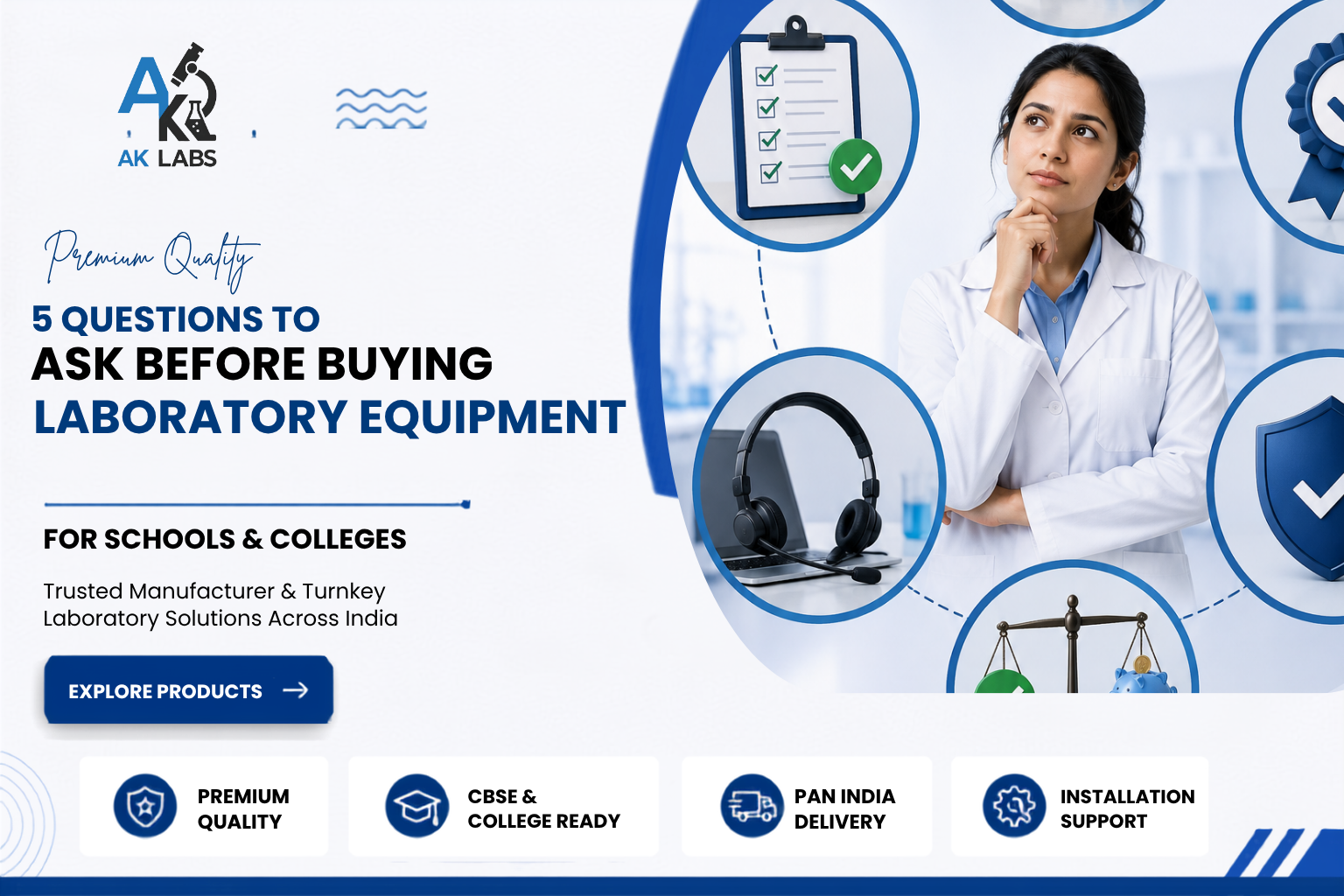
Buying laboratory equipment is an important investment for schools, colleges, and educational institutions. Here are 5 essential questions to ask before purchasing laboratory equipment to ensure quality, suitability, safety, and long-term value.
Choosing the right laboratory equipment is an important decision for schools, colleges, universities, and educational institutions. Laboratory instruments are used regularly by students, teachers, researchers, and laboratory staff, so quality, accuracy, durability, and safety should always be considered before making a purchase.
With many manufacturers and suppliers available, it can sometimes be difficult to decide which equipment is the right choice.
Before placing a laboratory equipment order, asking the right questions can help you make a better purchasing decision and avoid unnecessary expenses.
Here are 5 important questions to ask before buying laboratory equipment.
1. Is the Equipment Suitable for Our Requirements?
The first question to ask is whether the equipment actually meets your laboratory's requirements.
Different laboratories have different needs. A Physics laboratory will require different instruments from a Chemistry or Biology laboratory.
Before purchasing, consider:
- Which subject will the equipment be used for?
- Which classes or students will use it?
- What experiments need to be performed?
- How frequently will the equipment be used?
- How many students will use it?
- Does it match the existing laboratory setup?
- Is it suitable for the required curriculum?
For example, a school setting up a Physics laboratory may need equipment for mechanics, optics, electricity, magnetism, heat, and measurement experiments.
Similarly, Chemistry laboratories may require glassware, heating equipment, measuring instruments, titration apparatus, and other laboratory accessories.
Choosing equipment according to actual requirements helps prevent both under-purchasing and unnecessary purchases.
2. What Is the Quality and Accuracy of the Equipment?
Price should not be the only factor when purchasing laboratory equipment.
Laboratory instruments are often used for measurements and experiments where accuracy is important. Poor-quality equipment can produce unreliable results and may need to be replaced sooner.
Before purchasing, ask the supplier about:
- Material quality
- Manufacturing quality
- Measurement accuracy
- Product specifications
- Durability
- Calibration, where applicable
- Quality control procedures
- Expected service life
For educational laboratories, equipment should be sufficiently robust to withstand regular student use while providing reliable results.
Why Quality Matters
High-quality laboratory equipment can:
- Provide more reliable experimental results
- Reduce frequent replacements
- Improve student learning
- Reduce equipment failures
- Improve laboratory safety
- Provide better long-term value
Instead of selecting equipment based solely on the lowest price, schools should consider the overall value and expected lifetime of the product.
3. Is the Equipment Safe for Students and Teachers?
Safety is one of the most important factors when purchasing laboratory equipment for educational institutions.
Students may have limited experience handling scientific instruments, glassware, electrical equipment, chemicals, or heating apparatus.
Before purchasing, ask:
- Is the equipment designed for safe laboratory use?
- Are appropriate safety features provided?
- Is the equipment suitable for the age group using it?
- Are operating instructions available?
- Does the supplier provide safety information?
- Are replacement parts available if required?
Schools should also consider additional safety equipment such as:
- Safety goggles
- Laboratory gloves
- Laboratory coats
- First aid boxes
- Fire extinguishers
- Safety signage
- Appropriate storage facilities
A laboratory should always be designed around safe and responsible practical learning.
4. Does the Supplier Provide Warranty and After-Sales Support?
Laboratory equipment is a long-term investment. Even good-quality equipment may occasionally require maintenance, replacement parts, repairs, or technical assistance.
Before placing an order, ask the supplier:
- Is a warranty provided?
- What does the warranty cover?
- How long is the warranty period?
- Is technical support available?
- Are spare parts available?
- What is the procedure for reporting damaged or defective equipment?
- Is installation or demonstration support available where required?
A supplier that provides proper after-sales support can make laboratory management much easier.
This is particularly important when purchasing multiple instruments or setting up a complete laboratory.
5. Is the Price Justified by the Quality and Features?
Budget is naturally an important consideration for schools and educational institutions.
However, the cheapest product is not always the most economical option in the long term.
When comparing prices, consider:
Product quality + features + durability + accuracy + warranty + after-sales support
rather than looking only at the initial purchase price.
Before comparing quotations, make sure the products being compared have similar:
- Specifications
- Materials
- Features
- Accuracy
- Quantities
- Warranty terms
- Accessories
A lower-priced product may sometimes have fewer features, lighter construction, or limited support.
Therefore, schools should compare overall value rather than price alone.
Bonus: What Should You Check in a Laboratory Equipment Quotation?
When receiving a quotation from a laboratory equipment supplier, check whether it clearly mentions:
- Product name
- Product specifications
- Quantity
- Unit price
- Total price
- Applicable taxes
- Warranty
- Delivery terms
- Installation requirements
- Payment terms
- Accessories included
- Validity of quotation
A detailed quotation makes it easier to compare suppliers and avoid misunderstandings during procurement.
Manufacturer vs Supplier: What Should You Choose?
Educational institutions may purchase equipment directly from manufacturers or through suppliers and distributors.
Buying directly from a manufacturer can sometimes provide advantages such as:
- Direct communication
- Product customization where available
- Better understanding of product specifications
- Bulk-order support
- Direct technical assistance
- Complete laboratory solutions
However, the most important factor is to choose a reliable and experienced supplier or manufacturer that can provide suitable products and dependable support.
Why Choose AK Labs for Laboratory Equipment?
AK Labs is a manufacturer and supplier of scientific and educational equipment for schools, colleges, and educational institutions.
Our product range covers multiple educational laboratory requirements, including:
- Physics Laboratory Equipment
- Chemistry Laboratory Equipment
- Biology Laboratory Equipment
- General Science Equipment
- STEM & Educational Learning Models
- Mathematics Lab Equipment
- Laboratory Furniture
- Complete Laboratory Setup Solutions
Whether you need individual laboratory apparatus or equipment for a complete school laboratory, AK Labs can help you identify suitable solutions based on your requirements.
Final Checklist Before Buying Laboratory Equipment
Before placing your order, ask yourself:
☑ Is this equipment suitable for our laboratory requirements?
☑ Is the quality and accuracy appropriate?
☑ Is it safe for students and teachers?
☑ Does the supplier provide warranty and after-sales support?
☑ Is the price justified by the quality and features?
If the answer to all five questions is yes, you are in a much better position to make an informed purchasing decision.
Conclusion
Purchasing laboratory equipment is more than simply comparing prices. Schools and educational institutions should consider quality, suitability, accuracy, safety, durability, warranty, and after-sales support before making a purchase.
Asking the right questions before ordering can help schools select equipment that supports effective practical learning and provides better long-term value.
Whether you are purchasing a few instruments or planning a complete laboratory setup, always work with a reliable laboratory equipment manufacturer or supplier who understands your requirements.
AK Labs provides scientific and educational laboratory solutions designed to support practical learning in modern educational institutions.
Frequently Asked Questions
What should I consider before buying laboratory equipment?
Consider the equipment's suitability, quality, accuracy, safety, durability, warranty, after-sales support, and overall value.
Should schools choose laboratory equipment based only on price?
No. Price is important, but schools should also consider quality, accuracy, durability, safety, warranty, and long-term value.
Why is laboratory equipment quality important?
Quality equipment can provide more reliable results, withstand regular use, improve safety, and reduce the need for frequent replacement.
Is warranty important when buying laboratory equipment?
Yes. A warranty can provide additional assurance and support if an eligible product develops a manufacturing defect or requires service.
Can AK Labs provide complete laboratory equipment?
Yes. AK Labs offers scientific and educational equipment across Physics, Chemistry, Biology, General Science, STEM, Mathematics, and complete laboratory solutions.