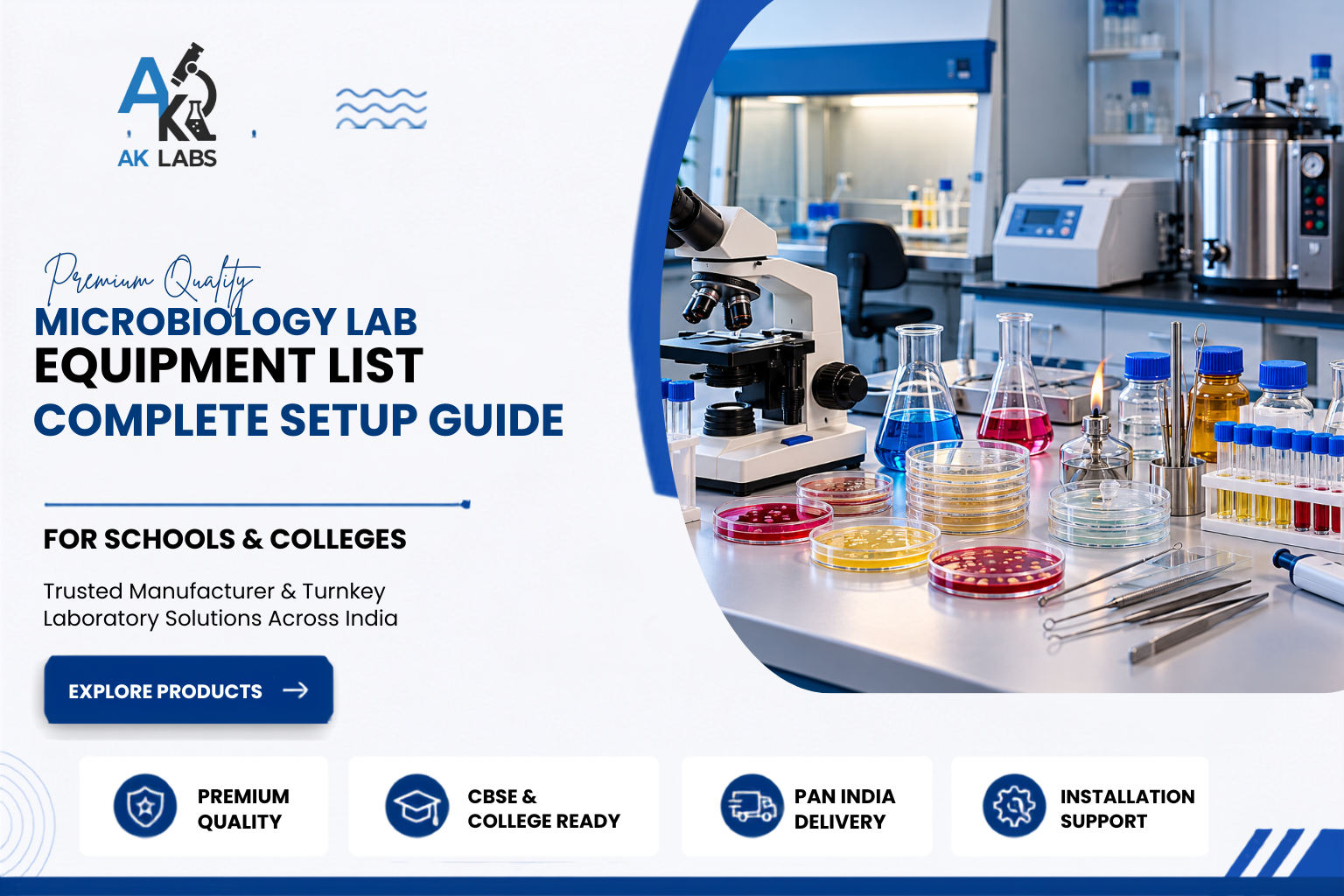
A microbiology laboratory is essential for studying microorganisms, conducting experiments, and developing practical scientific skills. From microscopes and autoclaves to incubators, culture media, and sterilization equipment, the right laboratory setup supports effective teaching, research, and testing.
Microbiology is the branch of science that studies microorganisms such as bacteria, fungi, and other microscopic forms of life. It plays an important role in education, healthcare, biotechnology, food testing, pharmaceutical research, and environmental science.
A well-equipped microbiology laboratory allows students and researchers to observe microorganisms, understand microbial growth, learn laboratory techniques, and develop practical scientific skills. Choosing the right equipment is essential for creating a safe, functional, and organized laboratory.
In this guide, we explore the essential microbiology lab equipment list, its uses, important safety requirements, and the key factors to consider when setting up a microbiology laboratory.
What Is a Microbiology Laboratory?
A microbiology laboratory is a specialized workspace designed for the observation, study, cultivation, and analysis of microorganisms under controlled conditions.
Depending on its purpose, a microbiology lab may be used for educational demonstrations, academic research, quality control, food analysis, pharmaceutical testing, or clinical investigations.
School and college laboratories generally focus on basic microscopy, prepared slides, safe demonstrations, and introductory practical activities. Advanced laboratories may require additional instruments, specialized facilities, validated procedures, and stricter biosafety controls.
Essential Microbiology Lab Equipment List
The equipment required depends on the laboratory's purpose, the level of study, the applicable curriculum, and the types of activities being performed.
1. Compound Microscope
A compound microscope is one of the most important instruments in a microbiology laboratory. It magnifies small specimens so that students can observe cells and other microscopic structures.
Common uses include:
-
Observing prepared slides of microorganisms.
-
Studying cell structures and basic microbial morphology.
-
Learning microscopy and slide-observation techniques.
-
Examining prepared biological specimens.
Schools and colleges should select microscopes with suitable magnification, reliable optics, adjustable illumination, and durable construction.
2. Autoclave
An autoclave uses pressurized steam to sterilize suitable laboratory materials and equipment.
Depending on the laboratory's procedures, it may be used for sterilizing compatible reusable instruments, media, and other materials. Its selection should consider capacity, operating requirements, safety features, and applicable validation procedures.
An autoclave must be operated by trained personnel according to the manufacturer's instructions and approved laboratory protocols.
3. Laboratory Incubator
An incubator maintains a controlled temperature for laboratory applications that require consistent environmental conditions.
Microbiology laboratories may use incubators for approved educational demonstrations, quality-control work, and other authorized procedures. The appropriate model depends on the required temperature range, capacity, temperature uniformity, and intended application.
For school laboratories, activities involving microorganisms should be limited to appropriately approved, low-risk educational materials and supervised procedures.
4. Laminar Airflow Cabinet and Biosafety Cabinet
These cabinets serve different purposes and should not be treated as interchangeable.
A laminar airflow cabinet provides filtered airflow to help protect the work area or product in suitable applications. It does not necessarily protect the operator or surrounding environment from biological hazards.
A properly selected and maintained biosafety cabinet is designed to provide specified levels of protection for personnel, the environment, and the work, depending on its class and configuration.
The choice should be based on a documented risk assessment and the laboratory's intended activities.
5. Petri Dishes
Petri dishes are shallow dishes commonly used in microbiology for approved culture-related demonstrations and laboratory procedures.
They may be available in disposable or reusable formats, depending on the application. Schools should select appropriate materials and follow institutional requirements for handling, storage, and disposal.
6. Test Tubes and Laboratory Glassware
Test tubes and other laboratory glassware are used for holding, preparing, or examining laboratory materials.
Common items include:
-
Test tubes and compatible racks.
-
Beakers and conical flasks.
-
Measuring cylinders.
-
Glass or plastic reagent containers.
-
Pipettes and suitable measuring tools.
Glassware should be selected according to the chemicals, temperatures, and procedures involved. Damaged glassware should be removed from service.
7. Centrifuge
A centrifuge separates components of a sample by spinning it at a controlled speed.
Depending on the laboratory's purpose, centrifuges may be used in educational demonstrations or more advanced laboratory procedures. Important selection factors include speed range, rotor compatibility, sample capacity, balancing requirements, and safety interlocks.
8. Analytical Balance
An analytical or precision balance is used to measure mass accurately when preparing materials or carrying out laboratory exercises.
The required balance depends on the precision needed, the expected sample weight, the operating environment, and calibration requirements.
9. pH Meter
A pH meter measures how acidic or alkaline a solution is.
It is useful in laboratories where students or staff need to understand solution properties, prepare suitable buffers, or check the pH of approved laboratory materials.
Reliable measurements require appropriate calibration, maintenance, and suitable storage of the electrode.
10. Refrigerator and Laboratory Storage
Some laboratory materials require controlled storage conditions. Depending on the application, a dedicated laboratory refrigerator may be appropriate.
Schools should follow supplier instructions and institutional policies for storing media, reagents, and other materials. Materials should be clearly labelled, separated where necessary, and stored at their specified conditions.
Other Important Microbiology Laboratory Supplies
In addition to major instruments, a microbiology laboratory may require:
-
Inoculating loops or other approved transfer tools.
-
Prepared slides and slide-storage boxes.
-
Approved prepared culture media.
-
Microscopy slides and cover slips.
-
Appropriate pipettes and dispensing accessories.
-
Laboratory labels and markers.
-
Personal protective equipment.
-
Biohazard waste containers and suitable waste-handling supplies.
-
Disinfectants approved for the intended use.
-
Handwashing facilities and laboratory cleaning supplies.
The final list should be prepared according to the laboratory's activities, risk assessment, and applicable regulations.
Safety Requirements for a Microbiology Lab
Safety is a fundamental part of microbiology laboratory planning. Even an educational laboratory needs suitable procedures, supervision, and facilities.
Important considerations include:
-
Providing appropriate lab coats, gloves, and eye protection.
-
Establishing clear handwashing and hygiene procedures.
-
Training users before they operate equipment.
-
Maintaining suitable cleaning and disinfection procedures.
-
Labelling and storing materials correctly.
-
Providing approved waste segregation and disposal arrangements.
-
Maintaining equipment and documenting relevant checks.
-
Restricting access to authorized users.
-
Following institutional biosafety procedures and applicable local requirements.
Educational laboratories should use approved materials and activities appropriate to the students' age, training, and level of supervision. Unknown or potentially hazardous microorganisms should not be cultured as unsupervised classroom activities.
How to Set Up a Microbiology Laboratory
Setting up a microbiology lab requires more than purchasing instruments. Schools, colleges, and institutions should plan the space, workflows, utilities, and safety provisions together.
Step 1: Define the Purpose
Identify whether the lab is intended for school-level education, college practicals, research, quality control, or another specialized purpose.
Step 2: Prepare an Equipment List
Create a list of required instruments, glassware, consumables, safety equipment, and storage facilities according to the planned activities.
Step 3: Plan the Laboratory Layout
Arrange workstations, storage areas, sinks, electrical points, and equipment so that the workspace is practical, accessible, and easy to maintain.
Step 4: Review Safety and Compliance Requirements
Determine the applicable biosafety requirements, waste-handling procedures, ventilation needs, and other facility requirements before purchasing or installing equipment.
Step 5: Select Suitable Equipment
Compare product specifications, capacity, reliability, warranty, service support, and suitability for the intended application.
Step 6: Arrange Training and Maintenance
Ensure that users receive appropriate training and that equipment is maintained, calibrated, or validated as required.
How to Choose the Right Microbiology Lab Equipment Supplier
Selecting a reliable supplier can help schools and institutions plan their laboratory requirements more effectively.
Before placing an order, consider:
-
Product specifications and intended applications.
-
Equipment quality and durability.
-
Suitability for the institution's curriculum or testing needs.
-
Availability of accessories and consumables.
-
Warranty and after-sales support.
-
Installation, demonstration, and service requirements.
-
Clear quotations, delivery terms, and documentation.
Schools establishing a new laboratory may benefit from discussing their complete equipment list with a supplier rather than purchasing unrelated products individually.
How AK Labs Can Support Educational Laboratory Setup
AK Labs supplies scientific and educational equipment for schools, colleges, and other educational institutions.
Institutions planning biology or microbiology-related teaching facilities can contact AK Labs to discuss their requirements for suitable educational laboratory instruments, models, glassware, and associated supplies.
The final equipment selection should reflect the intended educational activities, available space, institutional safety requirements, and budget.
Contact AK Labs to discuss your laboratory equipment requirements and request a quotation for your institution.
Conclusion
A well-planned microbiology laboratory helps students and professionals develop practical knowledge of microorganisms and laboratory techniques. Essential equipment may include microscopes, incubators, autoclaves, glassware, balances, pH meters, and appropriate safety supplies.
The most suitable equipment list depends on the laboratory's purpose, users, and applicable safety requirements. By planning carefully, selecting suitable equipment, and establishing appropriate procedures, schools and institutions can create an organized environment for effective microbiology education and laboratory work.