Discover the key differences between STEM labs and traditional science labs, including their equipment, learning methods, activities, benefits, and role in modern school education.
Science education is evolving beyond textbooks and theoretical learning. Schools are increasingly focusing on practical activities that allow students to experiment, create, solve problems, and apply their knowledge to real-world situations. Two important learning environments used in schools today are traditional science laboratories and STEM laboratories.
Although both encourage practical learning, they have different purposes, equipment, teaching approaches, and student activities. Understanding these differences can help schools choose the right laboratory setup for their educational requirements.
What Is a Traditional Science Lab?
A traditional science laboratory is designed mainly for practical experiments related to specific subjects such as Physics, Chemistry, and Biology.
Students usually perform experiments by following instructions provided by their teachers, textbooks, or laboratory manuals. These activities help students understand scientific concepts through observation, measurement, experimentation, and analysis.
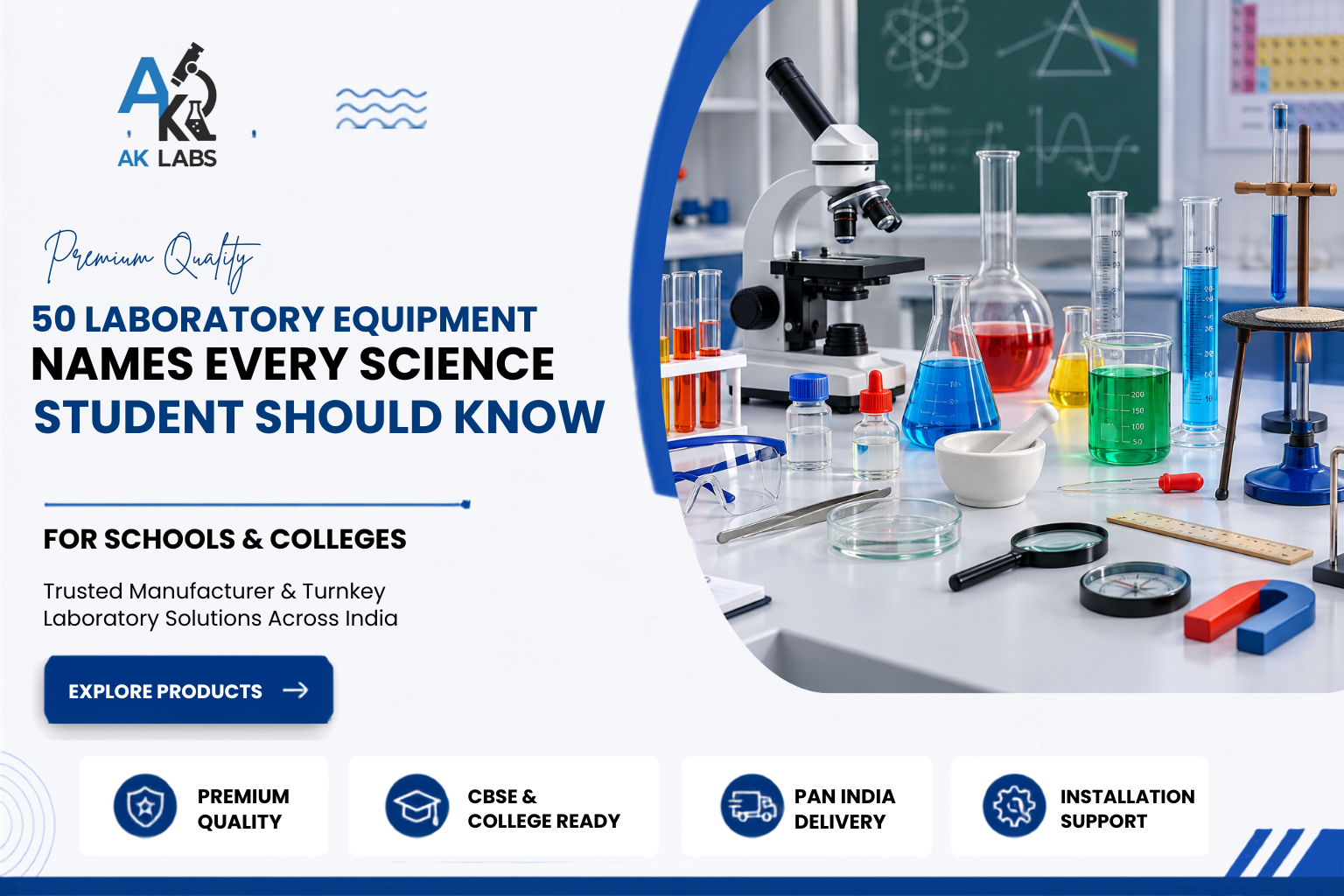
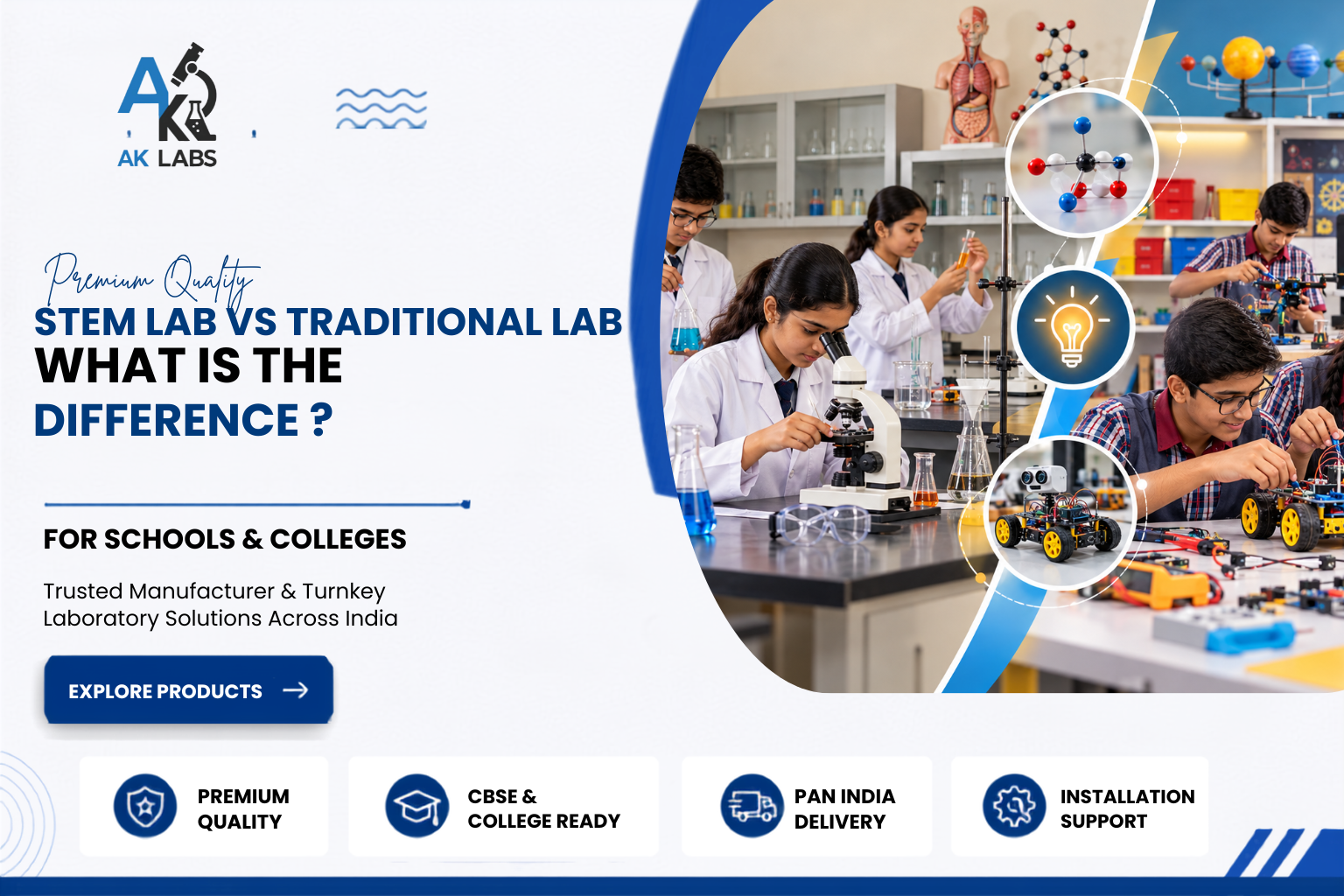
A traditional science laboratory may include microscopes, test tubes, beakers, measuring cylinders, physics apparatus, optical instruments, electrical and magnetic models, chemistry glassware, biology models, balances, heating equipment, and laboratory safety equipment.
What Is a STEM Lab?
A STEM lab is a multidisciplinary learning environment based on four major areas: Science, Technology, Engineering, and Mathematics.
Unlike a traditional science laboratory, a STEM lab focuses on hands-on learning, problem-solving, creativity, innovation, design, and real-world applications.
Students may be given a problem or challenge and encouraged to design, build, test, and improve their own solutions. This makes STEM learning more interactive, project-based, and collaborative.
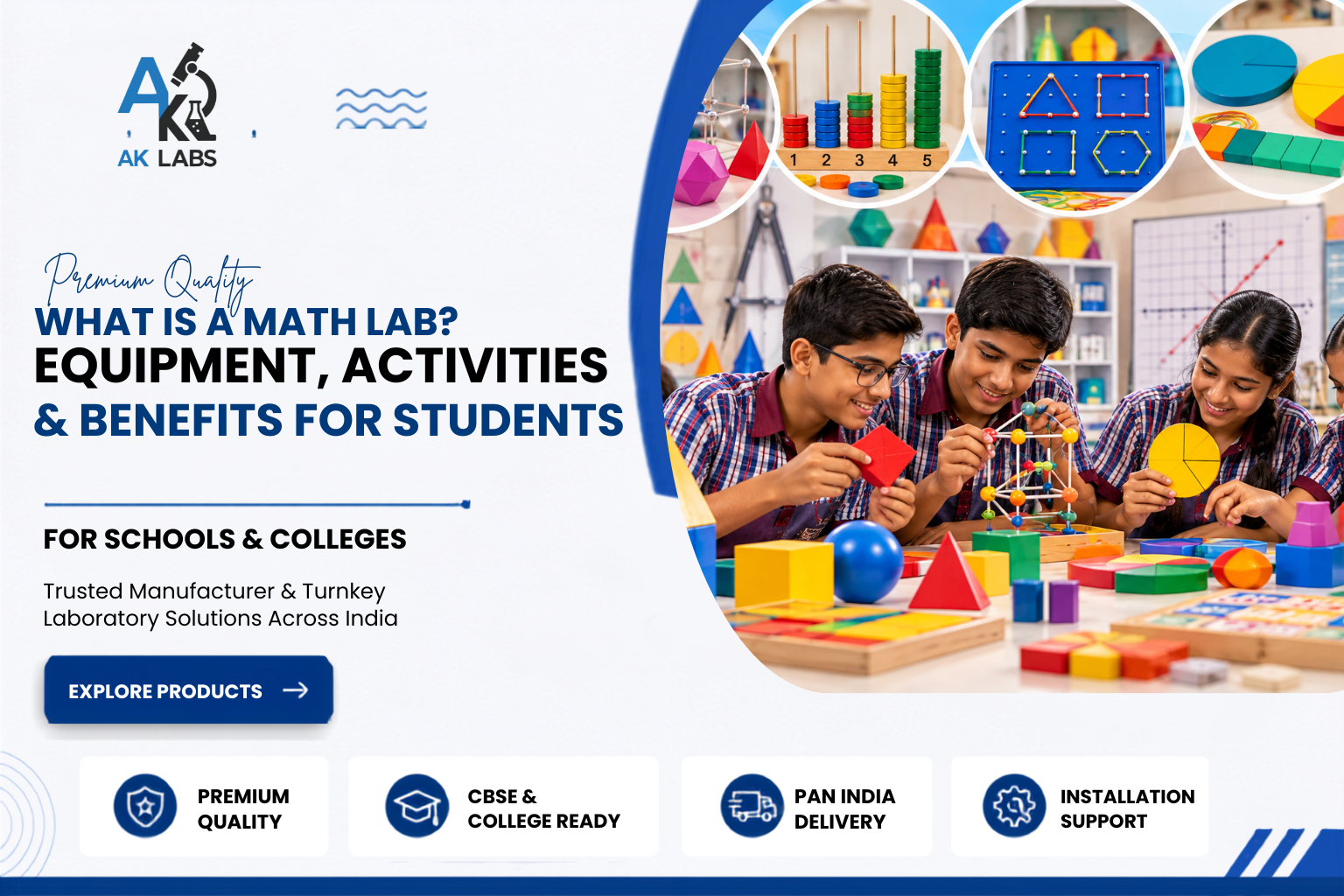
A STEM lab may include STEM educational kits, robotics and coding kits, engineering models, electronics and circuit kits, mathematics learning models, renewable energy models, mechanical projects, and science demonstration models.
Key Differences Between a STEM Lab and Traditional Science Lab
Learning Approach:
Traditional science labs generally focus on structured experiments with defined procedures. STEM labs encourage students to explore ideas, develop solutions, test their designs, and make improvements.
Subject Focus:
Traditional science labs mainly focus on Physics, Chemistry, and Biology. STEM labs combine Science, Technology, Engineering, and Mathematics.
Student Participation:
In traditional laboratories, students generally perform experiments according to established procedures. In STEM labs, students can actively design, build, test, and modify projects.
Problem-Solving:
Traditional experiments help students understand scientific principles through practical observation. STEM activities often begin with a problem or challenge and encourage students to develop their own solutions.
Creativity and Innovation:
Traditional experiments usually have a defined procedure and expected outcome. STEM activities provide more opportunities for students to experiment with different ideas and create innovative solutions.
Teamwork:
Traditional laboratory activities may be performed individually or in groups. STEM projects often involve teamwork, communication, collaboration, and sharing ideas.
Benefits of a Traditional Science Lab
Traditional science laboratories help students develop a strong foundation in scientific concepts and practical skills.
Students can develop:
• Observation and measurement skills
• Experimental skills
• Laboratory instrument handling
• Data recording and analysis
• Scientific reasoning
• Understanding of scientific principles
• Laboratory safety practices
A well-equipped traditional science laboratory remains an important part of practical education, particularly for schools following structured science curricula.
Benefits of a STEM Lab
STEM laboratories provide students with opportunities to learn through experimentation, creativity, and problem-solving.
A STEM lab can help students develop:
• Critical thinking
• Problem-solving skills
• Creativity and innovation
• Teamwork and communication
• Engineering and design skills
• Logical thinking
• Practical application of mathematics
• Technology skills
STEM activities can also help students understand how classroom concepts can be applied to real-world situations.
Why Are STEM Labs Important in Modern Schools?
Modern education increasingly focuses on developing practical skills alongside academic knowledge. STEM education connects different subjects and helps students understand how scientific and mathematical concepts can be applied to solve practical problems.
For example, students may use Physics to understand how a machine works, Mathematics for calculations, Engineering to develop a design, and Technology to test or control a project.
This interdisciplinary approach can make learning more engaging and help students understand the connection between different subjects.
Can a School Have Both a STEM Lab and a Traditional Science Lab?
Yes. A STEM lab does not necessarily replace a traditional science laboratory. Both can serve different educational purposes.
A traditional science laboratory provides students with opportunities to perform subject-specific experiments, while a STEM lab encourages interdisciplinary projects, innovation, creativity, and problem-solving.
Schools can therefore use both environments to provide students with a wider range of practical learning experiences.
What Should Schools Consider When Setting Up a STEM Lab?
Before setting up a STEM laboratory, schools should consider the following factors:
Curriculum Requirements:
The laboratory should support the school's curriculum and the learning requirements of the students.
Available Space:
The laboratory should have enough space for students to work safely, collaborate, build models, and conduct activities.
Equipment Selection:
Equipment should be selected according to learning objectives and student requirements. STEM resources should encourage experimentation, creativity, and practical application.
Safety:
Proper storage, electrical safety, workspace organisation, and supervision should be considered during laboratory planning.
Student Age Group:
STEM activities and equipment should be appropriate for the age and learning level of students.
STEM Lab or Traditional Science Lab: What Does Your School Need?
The choice depends on the school's educational objectives.
A traditional science laboratory is primarily designed for structured practical experiments in Physics, Chemistry, and Biology. A STEM lab focuses more broadly on interdisciplinary learning, innovation, engineering, technology, and problem-solving.
Rather than considering them as replacements for one another, schools can use both types of laboratories to create a more comprehensive practical learning environment.
Building a Modern Learning Environment with AK Labs
AK Labs provides scientific equipment, educational models, STEM learning resources, laboratory equipment, and solutions for schools and educational institutions.
From Physics, Chemistry, and Biology laboratory equipment to STEM and educational learning models, the right combination of resources can help schools create practical and engaging learning environments.
Schools planning a new laboratory or upgrading an existing facility can consider their curriculum, available space, student requirements, and learning objectives before selecting laboratory equipment.
Conclusion
Both STEM labs and traditional science laboratories play an important role in practical education. Traditional science laboratories help students understand scientific concepts through structured experiments, while STEM labs encourage interdisciplinary learning, creativity, engineering, technology, and problem-solving.
For modern schools, combining subject-based science laboratories with hands-on STEM learning opportunities can provide students with diverse ways to explore, experiment, and apply their knowledge.
Looking for STEM lab equipment or complete science laboratory solutions for your school? Explore the educational and laboratory solutions available from AK Labs.