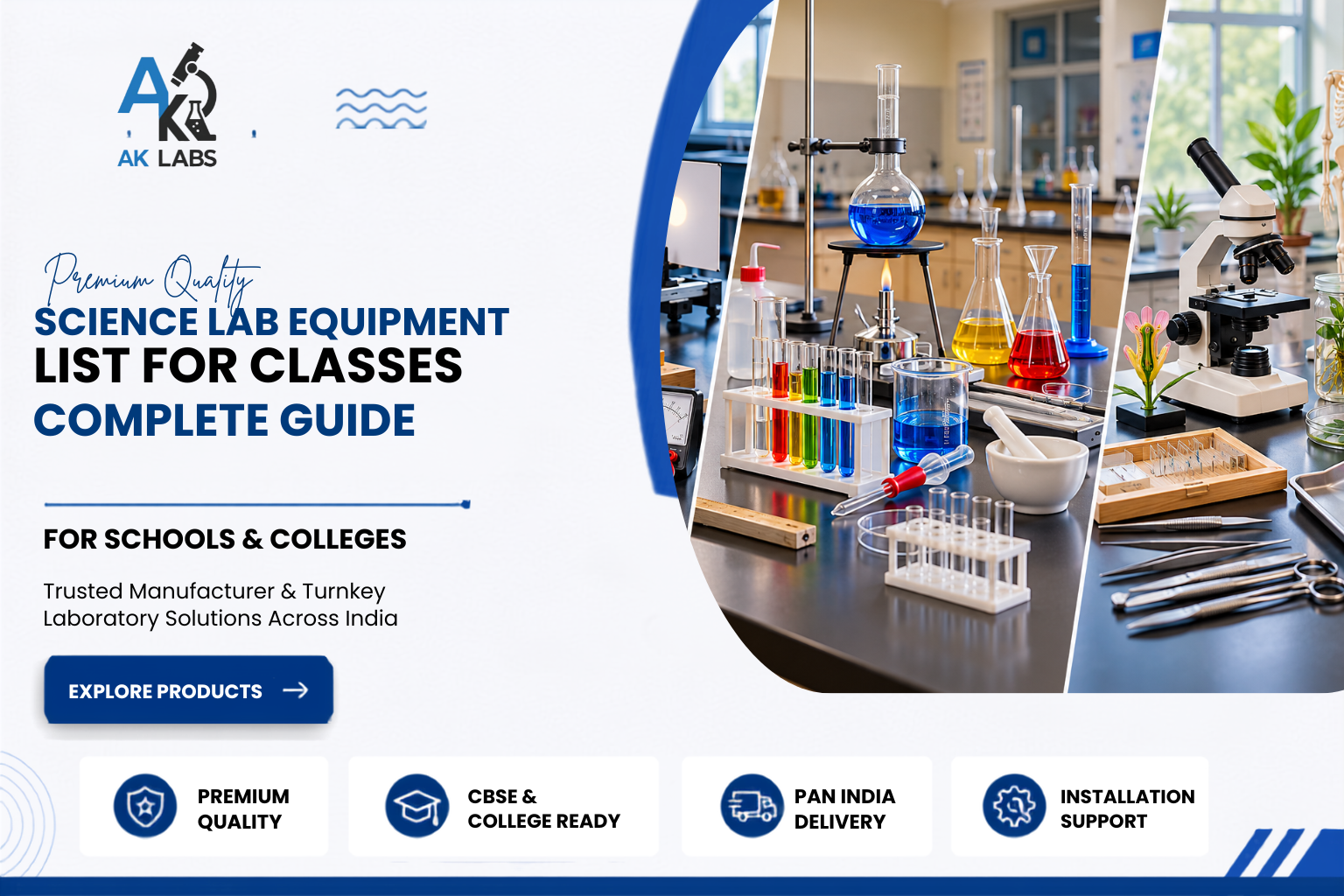
Explore the essential science lab equipment required for Classes 9 to 12, including Physics, Chemistry, and Biology apparatus. Learn about important instruments, practical experiment resources, and safety equipment schools should consider when setting up or upgrading their laboratories.
Science laboratories play an important role in secondary and senior secondary education. Students in Classes 9 to 12 learn scientific concepts through practical experiments, demonstrations, observations, and measurements.
A well-equipped school laboratory helps students connect theoretical knowledge with real-world applications. From Physics instruments and Chemistry glassware to Biology microscopes and specimen models, each piece of equipment supports specific practical learning objectives.
For schools planning a new laboratory or upgrading existing facilities, understanding the essential science lab equipment required for Classes 9 to 12 is an important first step.
Why Is Science Lab Equipment Important for Classes 9 to 12?
Practical learning helps students understand scientific principles beyond textbooks.
A properly equipped laboratory can help students develop:
-
Practical experimental skills
-
Scientific observation
-
Measurement and calculation
-
Logical thinking
-
Data recording and analysis
-
Problem-solving abilities
-
Laboratory safety awareness
Equipment requirements vary according to the curriculum, class level, experiments, and number of students.
1. Physics Lab Equipment List
Physics laboratories help students understand motion, force, electricity, magnetism, light, sound, and other physical phenomena.
Essential Physics Equipment
-
Metre scale
-
Vernier calipers
-
Screw gauge
-
Stopwatch
-
Physical balance
-
Spring balance
-
Pendulum apparatus
-
Inclined plane apparatus
-
Pulley systems
-
Weights and weight boxes
-
Thermometers
-
Measuring cylinders
-
Laboratory stands and clamps
Electricity and Magnetism Equipment
-
Ammeter
-
Voltmeter
-
Galvanometer
-
Rheostat
-
Resistance wire
-
Resistors
-
Connecting wires
-
Electric circuit boards
-
Bar magnets
-
Magnetic compass
-
Deflection magnetometer
-
Electric motor and generator models
Optics Equipment
-
Concave and convex lenses
-
Concave and convex mirrors
-
Optical benches
-
Glass prisms
-
Ray boxes
-
Plane mirrors
-
Lens holders
-
Screen and object holders
These instruments support practical activities involving measurements, mechanical principles, electrical circuits, magnetic fields, and the behaviour of light.
2. Chemistry Lab Equipment List
Chemistry laboratories require apparatus for preparing solutions, measuring liquids, heating substances, observing reactions, and conducting experiments.
Essential Chemistry Apparatus
-
Beakers
-
Test tubes
-
Test tube holders
-
Conical flasks
-
Volumetric flasks
-
Measuring cylinders
-
Pipettes
-
Burettes
-
Funnels
-
Glass rods
-
Watch glasses
-
Evaporating dishes
-
Mortar and pestle
-
Spatulas
-
Droppers
Heating and Measurement Equipment
-
Laboratory burners or suitable heating equipment
-
Tripod stands
-
Wire gauze
-
Test tube racks
-
Thermometers
-
Laboratory balances
-
pH paper or pH meters
-
Measuring instruments
Safety Equipment for Chemistry Labs
-
Safety goggles
-
Chemical-resistant gloves
-
Lab coats
-
First-aid supplies
-
Fire safety equipment
-
Chemical storage cabinets
-
Safety signage
-
Appropriate waste containers
Chemistry apparatus should be selected according to the experiments permitted by the school's curriculum and the laboratory's safety arrangements.
3. Biology Lab Equipment List
Biology laboratories help students study living organisms, plant structures, cells, tissues, and biological processes.
Essential Biology Equipment
-
Compound microscopes
-
Prepared microscope slides
-
Blank slides and coverslips
-
Petri dishes
-
Forceps
-
Dissecting needles
-
Dissecting trays
-
Scalpels for supervised activities
-
Droppers
-
Glass slides
-
Specimen containers
-
Hand lenses
-
Measuring instruments
Biology Models and Charts
-
Human torso model
-
Human skeleton model
-
Human heart model
-
Human brain model
-
Eye and ear models
-
Plant cell model
-
Animal cell model
-
Flower structure model
-
DNA model
-
Biology charts and diagrams
Additional Biology Resources
-
Biological specimens, where appropriate
-
Prepared slides
-
Plant specimens
-
Observation tools
-
Sample storage materials
These resources help students visualise biological structures and understand concepts that may be difficult to observe directly.
4. General Laboratory Equipment
In addition to subject-specific apparatus, schools may need shared equipment for laboratory activities.
Common examples include:
-
Laboratory balances
-
Thermometers
-
Measuring cylinders
-
Laboratory stands
-
Storage racks
-
Timers and stopwatches
-
Protective equipment
-
Cleaning materials
-
Laboratory furniture
-
Storage cabinets
The quantity of each item should be based on student strength, the number of practical groups, and the school's timetable.
5. Science Lab Equipment for Class 9 and Class 10
Classes 9 and 10 generally focus on building a foundation in scientific concepts and practical skills.
Equipment may support activities involving:
-
Measurement and motion
-
Force and simple machines
-
Light and lenses
-
Basic electrical circuits
-
Acids, bases, and indicators
-
Separation techniques
-
Chemical reactions
-
Cells and biological structures
-
Plant and animal tissues
-
Human body systems
Schools should select apparatus that matches their prescribed syllabus and practical activities.
6. Science Lab Equipment for Class 11 and Class 12
Classes 11 and 12 generally require more specialised equipment for advanced practical work.
Physics
-
Precision measuring instruments
-
Optical benches and lens kits
-
Electrical circuit apparatus
-
Resistance measurement equipment
-
Galvanometers and related instruments
-
Semiconductor or electronic components, where required
Chemistry
-
Burettes and pipettes
-
Volumetric glassware
-
Laboratory balances
-
pH measurement equipment
-
Titration apparatus
-
Suitable heating and filtration equipment
Biology
-
Compound microscopes
-
Prepared slides
-
Dissection equipment for supervised practicals
-
Biological models
-
Specimen observation materials
-
Laboratory accessories for experiments
The final equipment list should be checked against the applicable board syllabus and prescribed practical requirements.
7. Laboratory Safety Equipment Every School Should Consider
Safety is essential when students work with laboratory instruments, glassware, chemicals, or heating equipment.
Important safety provisions may include:
-
Safety goggles
-
Suitable protective gloves
-
Laboratory coats
-
First-aid supplies
-
Fire extinguishers appropriate for the laboratory
-
Eyewash facilities where required
-
Chemical spill management materials
-
Clear safety signage
-
Proper ventilation
-
Safe chemical storage
Teachers should supervise practical activities and ensure students receive appropriate safety instructions before experiments begin.
8. How to Choose the Right Science Lab Equipment
Before purchasing laboratory equipment, schools should evaluate the following factors.
Curriculum Requirements
Prepare the equipment list according to the prescribed syllabus and practical experiments for Classes 9 to 12.
Quality and Accuracy
Choose instruments suitable for the intended experiments, with appropriate accuracy and construction.
Student Strength
Estimate quantities based on the number of students, group sizes, and frequency of practical sessions.
Safety
Ensure equipment and materials are appropriate for student use and can be handled under suitable supervision.
Budget Planning
Prioritise essential equipment first, then plan additional models and demonstration resources according to available funds.
Supplier Support
Check product specifications, delivery arrangements, warranty terms, and after-sales support before placing an order.
9. Common Mistakes to Avoid When Purchasing Lab Equipment
Schools can improve purchasing decisions by avoiding these common mistakes:
-
Buying equipment without checking the syllabus
-
Selecting products based only on price
-
Ordering incorrect quantities
-
Overlooking safety equipment
-
Ignoring storage requirements
-
Purchasing instruments unsuitable for the intended experiments
-
Failing to check warranty and replacement terms
-
Forgetting future laboratory requirements
A carefully prepared checklist helps schools plan their purchases more efficiently.
10. How AK Labs Supports School Science Laboratories
AK Labs provides scientific equipment, educational models, laboratory apparatus, STEM learning resources, and laboratory solutions for schools and educational institutions.
Schools can plan their Physics, Chemistry, and Biology laboratories according to their curriculum, available space, student strength, and practical learning objectives.
Whether a school is setting up a new laboratory or upgrading existing facilities, selecting suitable equipment can help create a better environment for practical science education.
Conclusion
A well-equipped science laboratory is an important part of science education for Classes 9 to 12. Physics instruments, Chemistry apparatus, Biology equipment, and suitable safety resources allow students to explore scientific concepts through practical activities.
Schools should prepare their equipment lists according to their syllabus, student requirements, laboratory space, safety needs, and budget.
Looking for science lab equipment for Classes 9 to 12? Explore Physics, Chemistry, Biology, and educational laboratory solutions from AK Labs