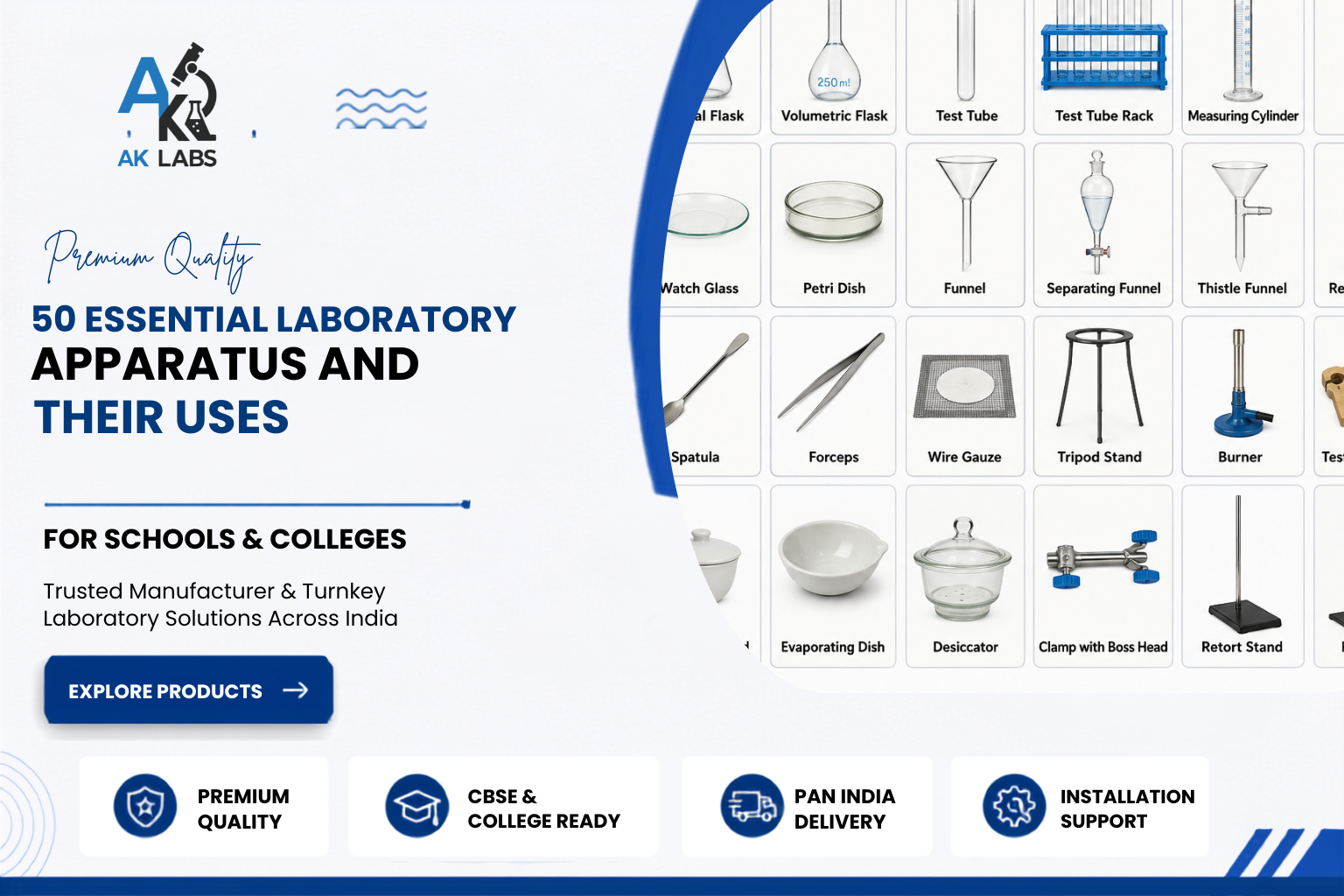
Discover 50 essential laboratory apparatus, their names, functions, and uses in Physics, Chemistry, Biology, and school science laboratories. A complete guide for students, teachers, and laboratory professionals.
Laboratories are an important part of science education and practical learning. From measuring liquids and conducting experiments to observing specimens and performing scientific calculations, the right laboratory apparatus helps students and professionals perform experiments safely and accurately.
Whether you are setting up a school science laboratory, upgrading an existing lab, or learning about laboratory equipment, understanding the names and uses of different apparatus is essential.
In this guide, we have listed 50 essential laboratory apparatus and their uses commonly found in Physics, Chemistry, Biology, and general science laboratories.
1. Beaker
A beaker is a cylindrical laboratory container generally used for holding, mixing, and heating liquids.
Uses: Preparing solutions, mixing chemicals, heating liquids, and transferring substances.
2. Measuring Cylinder
A measuring cylinder is used to measure the volume of liquids with reasonable accuracy.
Uses: Measuring and transferring specific quantities of liquids during experiments.
3. Test Tube
A test tube is a small cylindrical glass or plastic container used for conducting small-scale experiments.
Uses: Holding, mixing, heating, and observing chemical reactions.
4. Test Tube Holder
A test tube holder is used to safely hold a test tube, particularly when it is being heated.
Uses: Handling hot test tubes during laboratory experiments.
5. Conical Flask
A conical flask has a wide base and narrow neck, making it useful for mixing liquids without easily spilling them.
Uses: Mixing solutions, preparing chemicals, heating liquids, and titration experiments.
6. Volumetric Flask
A volumetric flask is designed to prepare solutions of a precise volume.
Uses: Preparing standard solutions and accurate chemical concentrations.
7. Pipette
A pipette is a laboratory instrument used to transfer measured quantities of liquid.
Uses: Accurate measurement and transfer of liquids during experiments.
8. Burette
A burette is a graduated tube with a control valve used for accurately dispensing liquids.
Uses: Mainly used in titration experiments to measure the volume of a solution delivered.
9. Dropper
A dropper is a small instrument used to transfer liquids one drop at a time.
Uses: Adding reagents or indicators in small quantities.
10. Funnel
A laboratory funnel helps transfer liquids into containers with narrow openings.
Uses: Pouring liquids and supporting filtration procedures when used with filter paper.
11. Bunsen Burner
A Bunsen burner is a laboratory heating device that produces a controlled flame.
Uses: Heating substances and conducting experiments that require a flame.
12. Spirit Lamp
A spirit lamp is a small heating device that uses alcohol or another suitable fuel.
Uses: Providing gentle heat during laboratory experiments.
13. Tripod Stand
A tripod stand is a three-legged support used during heating experiments.
Uses: Supporting beakers, flasks, and wire gauze above a heat source.
14. Wire Gauze
Wire gauze is a metal mesh placed on a tripod or stand.
Uses: Supporting glassware and distributing heat evenly during heating.
15. Crucible
A crucible is a heat-resistant container used for heating substances to high temperatures.
Uses: Heating solids and conducting high-temperature chemical experiments.
16. Evaporating Dish
An evaporating dish is a heat-resistant dish used to evaporate solvents from solutions.
Uses: Concentrating solutions and obtaining solid residues.
17. Water Bath
A water bath provides gentle and controlled heating using hot water.
Uses: Heating temperature-sensitive substances and maintaining a controlled temperature.
18. Heating Mantle
A heating mantle is an electrical heating device designed for laboratory vessels such as round-bottom flasks.
Uses: Providing controlled and uniform heating during experiments.
19. Retort Stand
A retort stand consists of a heavy base and vertical rod used to support laboratory apparatus.
Uses: Supporting burettes, flasks, thermometers, and other equipment.
20. Test Tube Stand
A test tube stand is used to keep test tubes upright.
Uses: Holding and organizing test tubes during experiments.
21. Laboratory Tongs
Laboratory tongs are gripping tools designed to handle hot or difficult-to-hold objects.
Uses: Handling crucibles, beakers, and other laboratory equipment safely.
22. Spatula
A laboratory spatula is a small tool used for transferring solid chemicals.
Uses: Measuring, transferring, and mixing small quantities of powdered substances.
23. Glass Rod
A glass rod is a simple solid glass instrument used for laboratory handling and mixing.
Uses: Stirring solutions and guiding liquids while pouring.
24. Mortar and Pestle
A mortar and pestle are used together to grind solid substances into smaller particles or powder.
Uses: Crushing and grinding chemicals and biological materials.
25. Watch Glass
A watch glass is a shallow, circular piece of glass.
Uses: Evaporating small quantities of liquids, holding substances, and covering beakers.
26. Forceps
Forceps are small gripping instruments used for handling delicate objects.
Uses: Handling small specimens, filter papers, and biological materials.
27. Vernier Caliper
A Vernier caliper is a precision measuring instrument used to measure dimensions accurately.
Uses: Measuring length, diameter, depth, and thickness of objects.
28. Screw Gauge
A screw gauge is a precision instrument used to measure very small dimensions.
Uses: Measuring the diameter of wires, thickness of sheets, and small objects.
29. Meter Scale
A meter scale is a graduated measuring instrument generally used to measure length.
Uses: Measuring distances and dimensions in Physics experiments.
30. Stopwatch
A stopwatch is an instrument used to measure time intervals accurately.
Uses: Measuring the duration of experiments and calculating time-dependent quantities.
31. Spring Balance
A spring balance measures force or weight using the extension of a spring.
Uses: Measuring force, weight, and studying mechanical principles.
32. Ammeter
An ammeter is an electrical measuring instrument used to measure electric current.
Uses: Measuring current in electrical circuits.
33. Voltmeter
A voltmeter is used to measure the potential difference between two points in an electrical circuit.
Uses: Measuring voltage during Physics and electrical experiments.
34. Galvanometer
A galvanometer is a sensitive instrument used to detect and measure small electric currents.
Uses: Detecting current and studying electrical circuits.
35. Resistance Box
A resistance box contains selectable resistance values.
Uses: Providing known resistance values in electrical experiments.
36. Rheostat
A rheostat is a variable resistor used to control the current flowing through an electrical circuit.
Uses: Adjusting current and studying the relationship between current and resistance.
37. Compound Microscope
A compound microscope is an optical instrument used to observe very small objects and specimens.
Uses: Observing cells, tissues, microorganisms, and prepared biological slides.
38. Dissecting Microscope
A dissecting microscope provides a magnified three-dimensional view of larger specimens.
Uses: Observing and examining biological specimens and performing basic dissections.
39. Prepared Slides
Prepared slides contain specimens mounted on glass slides for microscopic observation.
Uses: Studying cells, tissues, microorganisms, and biological structures.
40. Specimen Jar
A specimen jar is a container used to preserve and store biological specimens.
Uses: Preserving specimens for observation and educational purposes.
41. Dissection Tray
A dissection tray provides a suitable surface for examining and dissecting specimens.
Uses: Conducting biological dissections and practical demonstrations.
42. Hand Lens
A hand lens is a simple magnifying instrument with a convex lens.
Uses: Examining small objects, specimens, plant structures, and other materials.
43. Laboratory Thermometer
A laboratory thermometer is used to measure the temperature of substances during experiments.
Uses: Measuring and monitoring temperature in Physics, Chemistry, and Biology experiments.
44. Laboratory Balance
A laboratory balance is used to measure the mass of substances with high accuracy.
Uses: Measuring chemicals, samples, and materials required for experiments.
45. Wash Bottle
A wash bottle is a container designed to dispense water or another suitable liquid through a narrow nozzle.
Uses: Washing laboratory glassware and rinsing materials during experiments.
46. Safety Goggles
Safety goggles protect the eyes from chemical splashes, particles, and other laboratory hazards.
Uses: Protecting the eyes during laboratory experiments and practical work.
47. Laboratory Gloves
Laboratory gloves provide protection for hands while handling chemicals, specimens, and laboratory materials.
Uses: Reducing direct contact with potentially harmful substances.
48. Laboratory Coat
A laboratory coat provides a protective layer over clothing during practical work.
Uses: Protecting clothing and providing an additional layer of protection in the laboratory.
49. Fire Extinguisher
A fire extinguisher is an essential safety device used to control small laboratory fires.
Uses: Emergency fire protection and improving laboratory safety.
50. First Aid Box
A first aid box contains basic medical supplies required for immediate assistance during minor injuries.
Uses: Providing initial care for minor cuts, burns, and other laboratory-related injuries.
Importance of Laboratory Apparatus
Proper laboratory apparatus is essential for accurate, safe, and effective practical learning. Different experiments require different instruments, and using the correct equipment helps students understand scientific concepts through hands-on experience.
Schools and colleges should select laboratory equipment based on the curriculum, quality requirements, safety standards, durability, and practical applications.
How to Choose Laboratory Equipment for Your School
Before purchasing laboratory equipment, consider:
- The requirements of the Physics, Chemistry, and Biology curriculum
- Quality and durability of the equipment
- Accuracy and reliability
- Laboratory safety requirements
- Number of students using the laboratory
- Availability of replacement parts and accessories
- Supplier experience and after-sales support
- Budget and long-term value
Choose Quality Laboratory Equipment from AK Labs
AK Labs is a manufacturer and supplier of scientific and educational laboratory equipment for schools, colleges, educational institutions, and laboratories.
From Physics and Chemistry laboratory apparatus to Biology equipment, STEM learning models, educational kits, and complete laboratory solutions, AK Labs provides equipment designed to support practical and effective science education.
For reliable laboratory equipment and complete lab setup solutions, explore the range of products available from AK Labs.
Conclusion
Laboratory apparatus plays an important role in practical science education. From simple equipment such as beakers, test tubes, and measuring cylinders to advanced Physics and Biology instruments, each apparatus has a specific purpose.
Understanding the names, functions, and uses of laboratory apparatus helps students, teachers, and laboratory professionals select and use equipment correctly.
If you are planning to establish or upgrade a school or college laboratory, choosing quality equipment from a reliable laboratory equipment manufacturer can help create a safe, effective, and well-equipped learning environment.
Frequently Asked Questions
What is laboratory apparatus?
Laboratory apparatus refers to the tools, instruments, containers, and equipment used to perform scientific experiments, measurements, observations, and practical activities.
What are the most common laboratory apparatus?
Common laboratory apparatus include beakers, test tubes, measuring cylinders, conical flasks, pipettes, burettes, funnels, thermometers, balances, microscopes, and various Physics instruments.
Why is laboratory equipment important?
Laboratory equipment allows students and researchers to perform experiments accurately, safely, and efficiently while developing practical scientific skills.
Which laboratory equipment is required for schools?
Schools commonly require Physics, Chemistry, Biology, and general science laboratory equipment according to their curriculum and practical requirements.