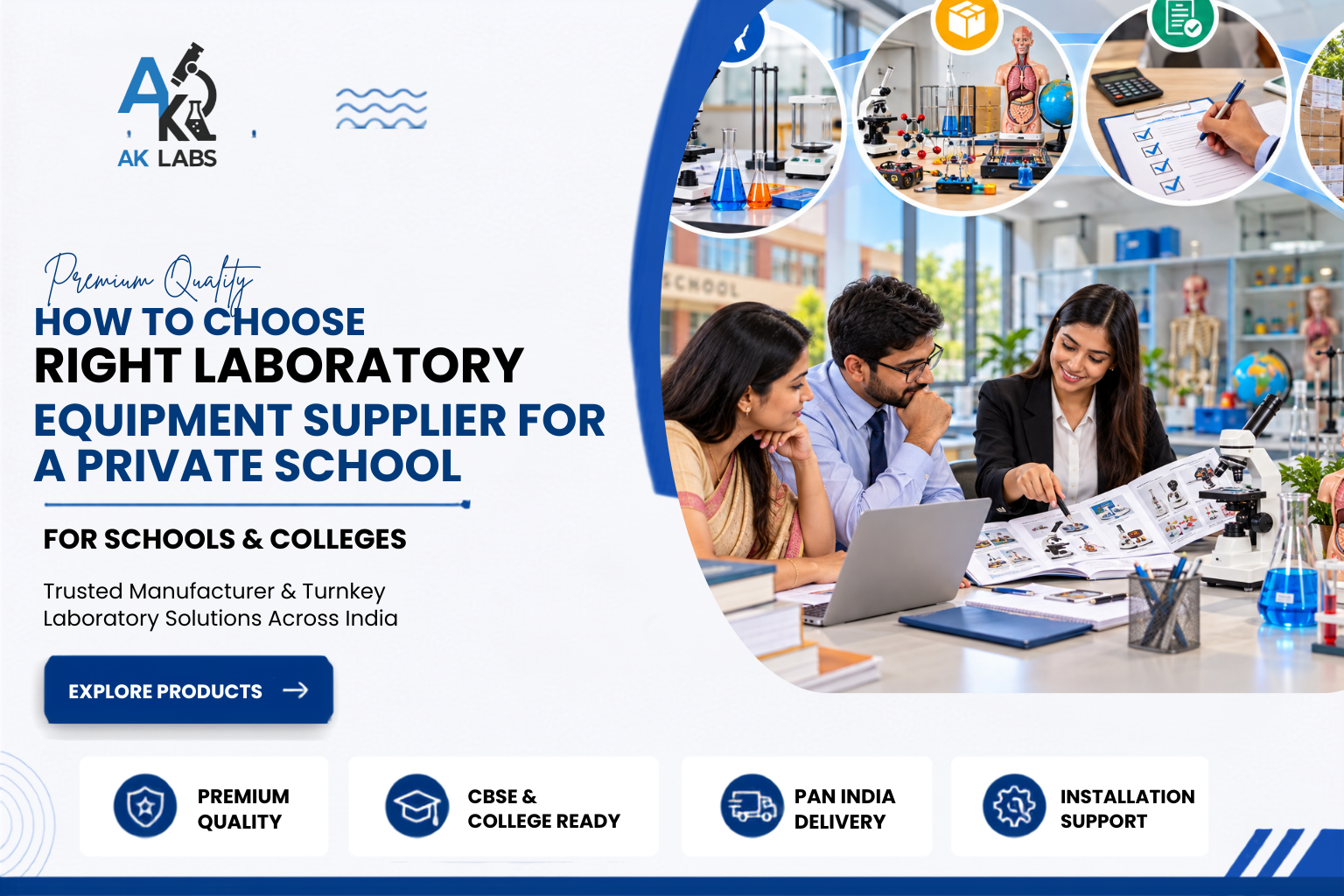
Choosing the right laboratory equipment supplier can help private schools build safe, reliable, and curriculum-aligned science labs. Learn what schools should check before selecting a supplier.
Setting up or upgrading a school laboratory is an important investment. For private schools, choosing the right laboratory equipment supplier is not simply about finding the lowest price. Schools need equipment that is safe, durable, curriculum-aligned, practical, and suitable for regular student use.
A reliable supplier can help schools select the right equipment, plan laboratory requirements, and create a practical learning environment for students.
Why Choosing the Right Supplier Matters
Laboratory equipment is used regularly by students and teachers. Poor-quality or unsuitable equipment can affect practical learning and may result in additional replacement costs.
Before selecting a supplier, schools should consider:
- Product quality
- Curriculum requirements
- Safety
- Durability
- Product range
- Pricing
- Warranty and support
- Delivery
- Installation requirements
- Supplier experience
1. Check the Supplier's Product Range
A good laboratory equipment supplier should offer a wide range of products for different subjects and educational levels.
For a school laboratory, this may include:
- Physics laboratory equipment
- Chemistry apparatus
- Biology laboratory equipment
- Microscopes
- Laboratory glassware
- Measuring instruments
- Science models
- Electrical equipment
- Optical equipment
- Laboratory safety products
If the school is planning a modern learning environment, the supplier may also provide STEM and Math Lab equipment.
2. Make Sure the Equipment Matches the Curriculum
Laboratory equipment should support the experiments and activities students are expected to perform.
Before purchasing, schools should identify:
- Classes using the laboratory
- Subjects covered
- Practical activities required
- Number of students
- Number of laboratory sessions
- Curriculum requirements
Choosing equipment based on actual learning requirements can help schools avoid purchasing unnecessary products.
3. Check Product Quality and Durability
School laboratory equipment may be used by many students over several academic years.
Schools should check:
- Material quality
- Construction
- Accuracy
- Finish
- Ease of use
- Expected durability
- Maintenance requirements
Durable equipment can be especially important for frequently used laboratory products.
4. Consider Laboratory Safety
Safety should be an important part of laboratory planning.
Schools should consider whether the equipment is appropriate for student use and whether the supplier provides suitable safety-related products and guidance.
Depending on the laboratory, schools may require:
- Safety goggles
- Gloves
- First-aid equipment
- Fire safety equipment
- Chemical storage solutions
- Safety signage
- Proper laboratory furniture
5. Compare Quality and Price
Price is an important consideration, but it should not be the only factor.
Schools should compare suppliers based on:
Product quality + features + durability + warranty + service + total cost
A low initial price may not always represent the lowest long-term cost if equipment requires frequent replacement.
6. Check Whether the Supplier Is a Manufacturer or Distributor
Schools may come across both manufacturers and distributors when purchasing laboratory equipment.
A manufacturer may offer direct access to products and technical information, while a distributor may provide products from multiple manufacturers.
Schools can ask:
- Who manufactures the product?
- Is the product supplied directly?
- Is technical support available?
- Are replacement parts available?
- What warranty is provided?
Understanding the supply chain can help schools make a more informed purchasing decision.
7. Ask About Warranty and After-Sales Support
Laboratory equipment may require maintenance, troubleshooting, or replacement parts.
Before placing an order, schools should ask about:
- Warranty period
- Replacement policy
- Technical support
- Spare parts
- Repair services
- Installation support
- Maintenance assistance
A supplier offering clear after-sales support can make laboratory management easier.
8. Check Delivery and Installation Services
Large laboratory projects may involve multiple products and equipment categories.
Schools should clarify:
- Expected delivery timeline
- Packaging
- Transportation
- Installation requirements
- Demonstration or training
- Site requirements
For a complete laboratory setup, proper planning of delivery and installation is particularly important.
9. Look for Complete Laboratory Solutions
Schools setting up a laboratory from scratch may need much more than individual equipment.
A complete laboratory project may involve:
- Laboratory furniture
- Physics equipment
- Chemistry equipment
- Biology equipment
- STEM resources
- Math Lab equipment
- Safety equipment
- Storage solutions
- Demonstration models
Working with a supplier that can coordinate multiple requirements can simplify the purchasing process.
10. Check Previous School Projects
Before finalising a supplier, schools can review the supplier's previous work and experience with educational institutions.
Schools can look for:
- Previous school laboratory projects
- Product catalogues
- Client references
- Installation photographs
- Product specifications
- Customer feedback
This can provide a better understanding of the supplier's experience and capabilities.
11. Ask for a Detailed Quotation
A detailed quotation makes it easier to compare different suppliers.
The quotation should clearly mention:
- Product name
- Quantity
- Specifications
- Unit price
- Applicable taxes
- Delivery charges
- Installation charges
- Warranty
- Other applicable costs
Schools should compare quotations based on the complete cost and specifications, rather than only comparing the final price.
12. Consider Future Laboratory Requirements
A laboratory should be planned with future requirements in mind.
Schools may expand their facilities as student numbers increase or as new educational activities are introduced.
A supplier should be able to discuss possible future requirements such as:
- Additional equipment
- STEM activities
- Advanced laboratory models
- New practical experiments
- Laboratory upgrades
Planning ahead can make future expansion easier.
Questions to Ask Before Choosing a Laboratory Equipment Supplier
Before placing an order, schools can ask:
- Does the equipment match our curriculum?
- What materials are used?
- Is the equipment suitable for student use?
- What warranty is provided?
- Is after-sales support available?
- Are spare parts available?
- What is the delivery timeline?
- Are installation services provided?
- Can the supplier provide complete laboratory solutions?
- Can the supplier support future expansion?
Why Schools Should Avoid Choosing Only on Price
Laboratory equipment is an investment in practical education. Choosing products only because they are inexpensive may result in compromises in quality, durability, or usability.
Schools should consider the overall value of the purchase, including product quality, expected usage, warranty, support, and long-term requirements.
Choosing a Laboratory Equipment Supplier for Your Private School
For a private school, the right supplier should be able to understand the school's educational objectives and provide equipment that supports practical learning.
A good purchasing process should begin with identifying the school's requirements and then comparing products, specifications, pricing, service, and support.
Laboratory Solutions from AK Labs
AK Labs provides scientific equipment, educational models, STEM learning resources, Math Lab equipment, and laboratory solutions for schools and educational institutions.
Schools can plan their laboratory requirements based on their curriculum, student strength, available space, and practical learning objectives.
From individual laboratory equipment to broader laboratory requirements, AK Labs can support schools in developing practical learning environments across Physics, Chemistry, Biology, STEM, and Mathematics.
Conclusion
Choosing the right laboratory equipment supplier is an important decision for any private school planning to establish or upgrade its laboratory.
Schools should look beyond price and evaluate quality, curriculum compatibility, safety, durability, product range, warranty, delivery, after-sales support, and future requirements.
A carefully selected supplier can help schools build laboratories that support practical learning and provide students with better opportunities to experiment, observe, and understand scientific concepts.
Planning a new school laboratory or upgrading an existing one? Explore laboratory equipment and educational solutions from AK Labs.