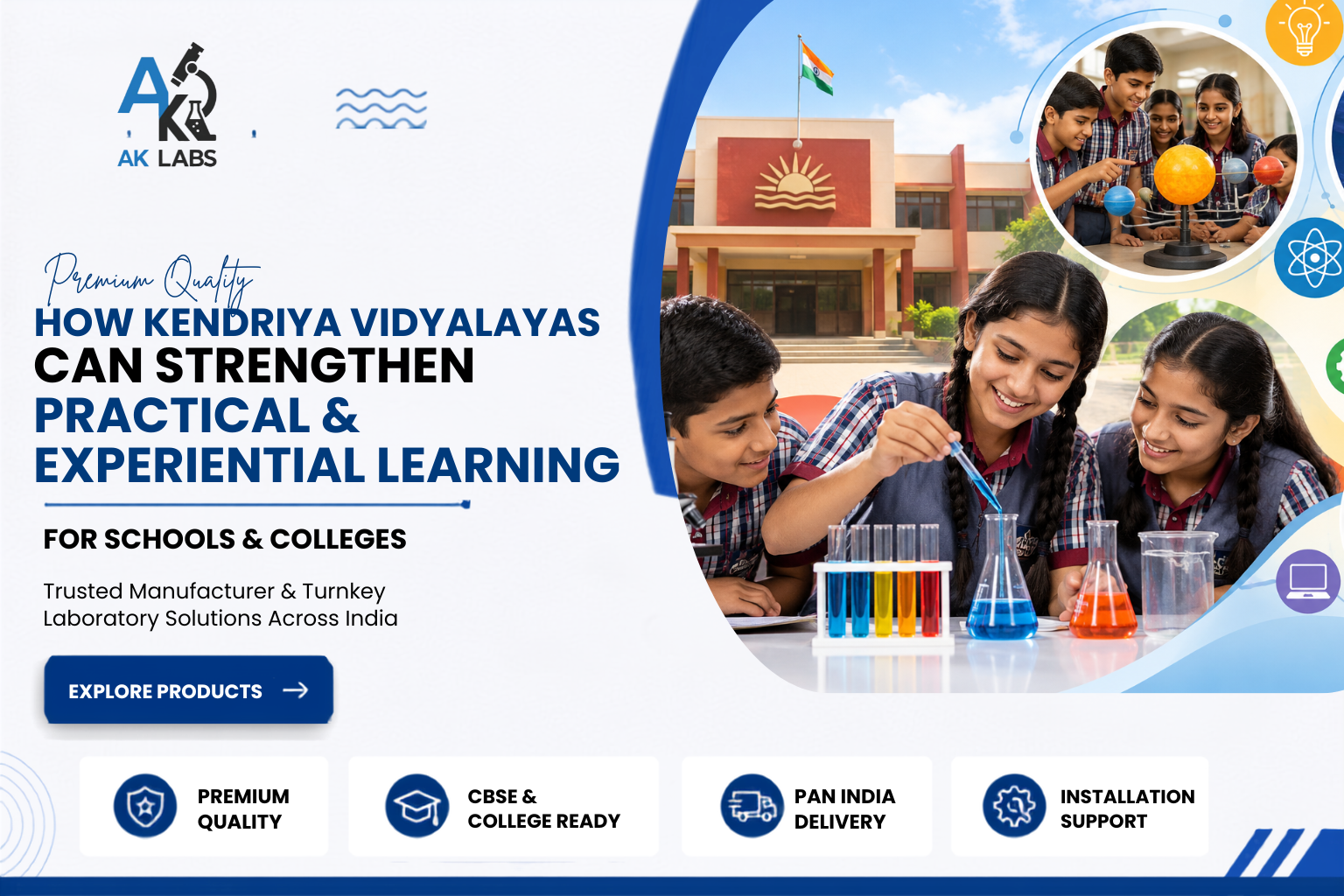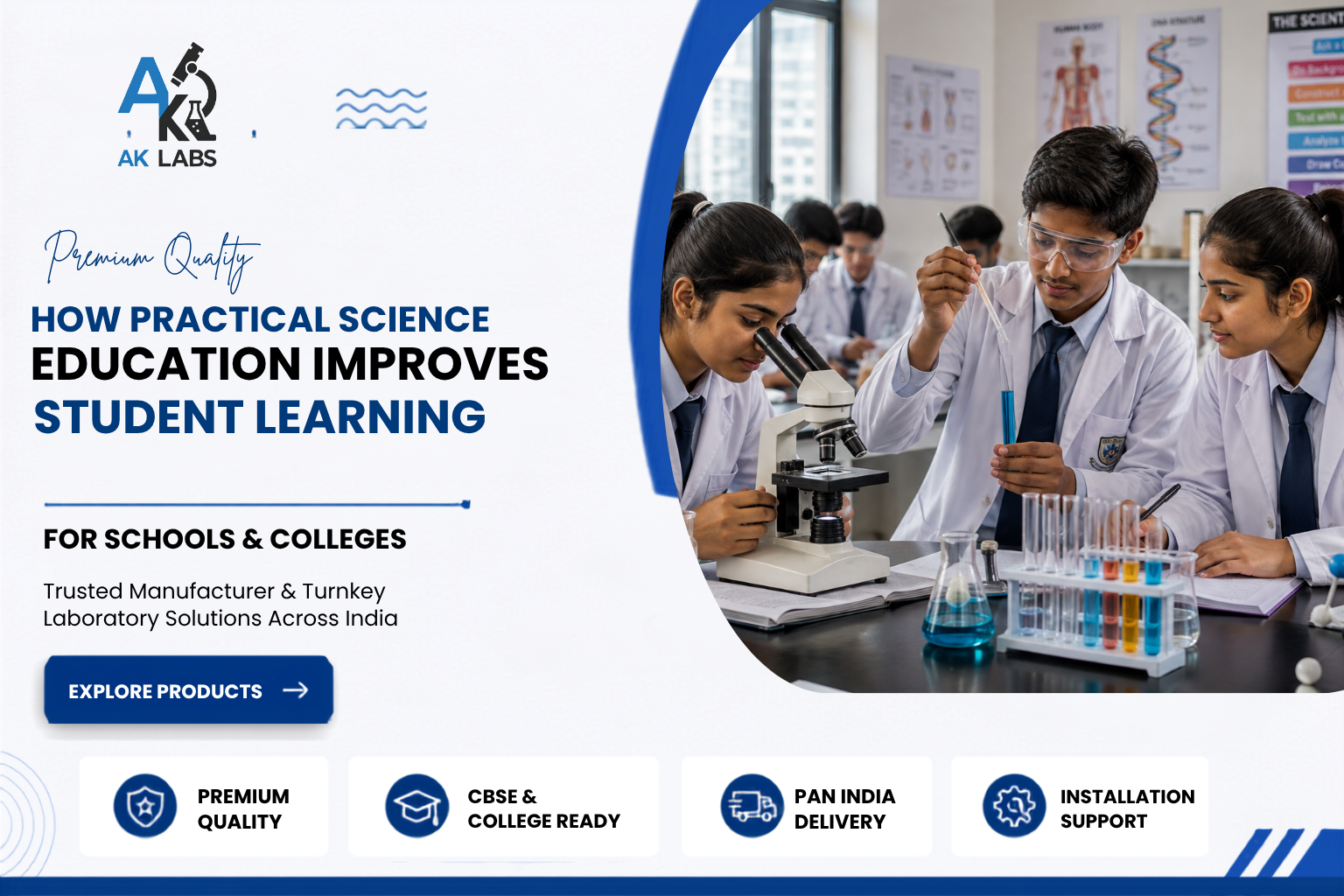
Discover how practical science education helps students understand concepts, develop critical thinking, improve problem-solving skills, and gain valuable hands-on experience through laboratory experiments and activities.
Science is not only about reading textbooks and memorizing formulas. Students understand science better when they have the opportunity to observe, experiment, question, and discover things for themselves.
Practical science education brings classroom concepts into the real world through laboratory experiments, demonstrations, projects, models, and hands-on activities.
A well-equipped science laboratory gives students an environment where they can apply theoretical knowledge and develop practical scientific skills.
In this article, we explore how practical science education improves student learning and why hands-on learning is becoming increasingly important in modern schools.
What Is Practical Science Education?
Practical science education involves learning science through activities that allow students to directly interact with scientific concepts.
Instead of only learning how something works from a textbook, students can perform experiments, use scientific instruments, observe results, collect data, and draw conclusions.
Examples include:
- Conducting Chemistry experiments
- Observing specimens through a microscope
- Measuring physical quantities in Physics
- Building STEM projects
- Performing demonstrations
- Creating scientific models
- Recording and analyzing experimental results
These activities make science more interactive and meaningful for students.
1. Helps Students Understand Difficult Concepts
Some scientific concepts can be difficult to understand through theory alone.
For example, students may learn about electrical circuits in a classroom, but actually connecting a circuit and observing how current flows can make the concept much easier to understand.
Similarly, experiments involving:
- Light
- Sound
- Magnetism
- Chemical reactions
- Electricity
- Cells
- Heat
- Motion
can help students connect theoretical information with real-world observations.
2. Makes Learning More Engaging
Traditional classroom learning can sometimes become repetitive when students only read textbooks or listen to lectures.
Practical activities give students the opportunity to actively participate in the learning process.
When students perform an experiment themselves, they are more likely to:
- Pay attention
- Ask questions
- Participate actively
- Discuss observations
- Remember what they have learned
This makes science lessons more interesting and engaging.
3. Develops Critical Thinking Skills
Science experiments rarely involve simply memorizing an answer.
Students need to observe what happens, think about why it happened, and use evidence to reach conclusions.
For example, during an experiment, students may need to ask:
What happened?
Why did it happen?
What would happen if we changed one variable?
Does the result support our prediction?
This type of learning encourages students to develop critical thinking and analytical skills.
4. Improves Problem-Solving Skills
Practical science activities often involve challenges.
An experiment may not produce the expected result. Equipment may need adjustment, measurements may need to be repeated, or students may need to identify an error.
Instead of simply receiving the correct answer, students learn how to investigate the problem and find a solution.
This develops problem-solving abilities that can be useful both inside and outside the classroom.
5. Improves Observation Skills
Observation is one of the fundamental skills of science.
Students learn to carefully observe:
- Changes in colour
- Temperature changes
- Chemical reactions
- Movement
- Shapes and structures
- Biological specimens
- Experimental results
Using microscopes, measuring instruments, models, and laboratory apparatus helps students become more attentive to details.
6. Connects Theory With Real-World Applications
One of the biggest advantages of practical learning is that it connects classroom knowledge with real-life situations.
For example:
Physics: Students can investigate force, motion, electricity, and optics through experiments.
Chemistry: Students can observe reactions, solutions, acids, bases, and other chemical processes.
Biology: Students can observe cells, tissues, specimens, and biological structures.
STEM: Students can combine science, technology, engineering, and mathematics to develop practical solutions.
This helps students understand why the concepts they learn are important.
7. Builds Scientific Skills
Laboratory activities help students develop important scientific skills such as:
- Measuring
- Recording observations
- Handling instruments
- Collecting data
- Conducting experiments
- Comparing results
- Analyzing information
- Drawing conclusions
- Maintaining laboratory records
These skills can become especially valuable for students who later pursue careers in science, engineering, medicine, technology, and research.
8. Encourages Curiosity
Good science education should encourage students to ask questions.
Practical experiments naturally create opportunities for curiosity.
A student may observe something unexpected and ask:
“Why did this happen?”
That question can lead to further investigation and learning.
When students are encouraged to explore scientific questions, they can develop a stronger interest in science.
9. Teaches Students to Learn From Mistakes
Not every experiment produces the expected result.
This is an important part of scientific learning.
Students can learn that mistakes and unexpected results are opportunities to investigate what went wrong.
They can review their method, identify possible errors, repeat the experiment, and improve their approach.
This helps develop patience, logical thinking, and a scientific attitude.
10. Encourages Teamwork
Many laboratory activities and STEM projects are conducted in groups.
Students may need to work together to:
- Plan an experiment
- Divide responsibilities
- Record observations
- Discuss results
- Prepare presentations
- Solve problems
Group activities help students develop communication and teamwork skills while learning science.
11. Improves Memory and Understanding
Students are more likely to remember information when they actively experience it.
For example, reading about a microscope provides theoretical knowledge, but using a microscope to observe a specimen creates a direct learning experience.
Practical activities therefore provide another way for students to understand and remember scientific concepts.
12. Builds Confidence
Successfully completing an experiment can give students a sense of achievement.
When students learn how to correctly use laboratory instruments and conduct experiments, their confidence can increase.
This can encourage them to participate more actively in future practical activities.
13. Supports Different Learning Styles
Students do not all learn in exactly the same way.
Some students learn particularly well through:
- Visual demonstrations
- Hands-on activities
- Group discussions
- Experiments
- Projects
- Observation
Practical science education provides multiple ways for students to interact with and understand scientific concepts.
Role of a Well-Equipped Science Laboratory
A properly designed and equipped laboratory plays an important role in practical science education.
Depending on the curriculum, schools may require equipment for:
Physics
- Mechanics experiments
- Optics experiments
- Electricity and magnetism
- Measurement activities
- Heat and thermodynamics
Chemistry
- Chemical reactions
- Solution preparation
- Titration
- Heating experiments
- Qualitative analysis
Biology
- Microscopy
- Specimen observation
- Cell studies
- Biological models
- Dissection activities
STEM
- Robotics
- Electronics
- Engineering projects
- Model building
- Problem-solving activities
The right equipment allows teachers to convert theoretical lessons into meaningful practical experiences.
How Teachers Can Make Practical Science More Effective
Teachers can make laboratory learning more effective by:
- Explaining the objective before starting an experiment.
- Demonstrating the correct use of equipment.
- Allowing students to participate actively.
- Encouraging students to make predictions.
- Asking students to record observations.
- Discussing unexpected results.
- Connecting experiments to everyday life.
- Encouraging students to ask questions.
- Following proper laboratory safety procedures.
- Discussing the results after completing the experiment.
Practical Learning and the Future of Education
Education is increasingly moving toward experiential and activity-based learning.
Modern science education is not limited to traditional laboratory experiments. Schools are also incorporating STEM projects, educational models, robotics, electronics, digital tools, and innovative learning activities.
These approaches can help students develop skills that extend beyond academic knowledge.
Practical science education can therefore play an important role in preparing students for a future where problem-solving, creativity, collaboration, scientific thinking, and innovation are increasingly valuable.
How AK Labs Supports Practical Science Education
AK Labs provides scientific and educational equipment designed to support practical learning in schools, colleges, and educational institutions.
Our range includes solutions for:
- Physics Laboratories
- Chemistry Laboratories
- Biology Laboratories
- General Science
- STEM Education
- Mathematics Laboratories
- Educational Models
- Science Learning Kits
- Complete Laboratory Solutions
By providing suitable laboratory equipment and educational learning solutions, AK Labs aims to help educational institutions create environments where students can learn science by doing.
Conclusion
Practical science education transforms learning from simply reading about science to experiencing science.
Through experiments, observations, models, laboratory instruments, and STEM activities, students can develop a deeper understanding of scientific concepts while improving critical thinking, problem-solving, observation, teamwork, and practical skills.
A well-planned science laboratory combined with effective teaching can give students valuable opportunities to explore, experiment, make mistakes, ask questions, and discover how science works in the real world.
For schools looking to strengthen practical science education, investing in quality laboratory equipment and hands-on learning resources can be an important step toward creating a more engaging learning environment.
Frequently Asked Questions
Why is practical science education important?
Practical science education helps students understand theoretical concepts through experiments and hands-on activities while developing scientific and problem-solving skills.
How does practical learning improve students' understanding?
Students can directly observe scientific concepts, conduct experiments, collect data, and analyze results, making abstract concepts easier to understand.
What skills do students develop through laboratory activities?
Students can develop observation, measurement, analytical thinking, problem-solving, teamwork, communication, and experimental skills.
How can schools improve practical science education?
Schools can improve practical learning by providing well-equipped laboratories, suitable educational models and STEM resources, trained teachers, and regular hands-on activities.
Is practical learning useful for all science subjects?
Yes. Practical learning can be used effectively in Physics, Chemistry, Biology, General Science, STEM, and other science-related subjects.